
Verdani’s 2026 Sustainability Trends: 10 Signals Defining the ESG Implementation Era

AUTHORS: CARLI SCHOENLEBER, PAULYNN CUE, GABE JOHN, VANESSA VLASAK
REVIEWERS: ZACHARY BROWN, SEAN BIRNBAUM, DANA WEISS, TAYLOR BULOW, SAM HOWLEY, SHUBHA MAHESHWARI, MAREN BENDER, MARY REAMES, NOAH GORDON

JANUARY 6, 2026
Introduction
Corporate sustainability reached a turning point in 2025 — shifting from market differentiator to core value driver, from bold claims to quieter, proof-based communication, and from primarily investor-driven pressure to formal regulatory requirements. Political backlash to environmental, social, and governance (ESG), tighter capital conditions, and heightened regulatory and legal scrutiny have forced companies to reassess not whether sustainability matters, but how it is executed, financed, and communicated.
Beneath the surface, sustainability has moved beyond an outward-facing, commitment-driven stage into a more mature phase defined by deeper operational integration and value creation. As regulations expand and climate risks accelerate, sustainability is increasingly considered in financial decision making. Carbon and energy performance are influencing asset valuation and underwriting; sustainability data is being held to financial-grade standards; and resilience and nature are emerging as material drivers of long-term performance. Sustainability communication, in turn, has become a test of governance and credibility, signaling whether sustainability is being managed with the same rigor as other core business priorities.
Although 2025 headlines often suggested a pullback, the reality is more nuanced. In the United States, corporate sustainability messaging has grown quieter amid rising political pressure, federal policy setbacks, economic volatility, and visible exits from high-profile climate coalitions. Yet sustainability programs are continuing both in the U.S. and globally (and in many cases intensifying) as the stakes of inaction rise — becoming more embedded in business strategy, capital allocation, and asset-level decision making.
Looking ahead to 2026, the imperative is implementation: moving sustainability from plans to execution. These 10 trends reflect Verdani’s view of how sustainability and ESG are shaping real estate, infrastructure, and capital markets, and why they are central to managing risk, controlling costs, and sustaining competitiveness.
Verdani’s 2026 Sustainability Trends

Up to now, we have seen an abundance of climate pledges — especially in real estate — yet true performance improvement is lagging far behind. The implementation gap between pledged action and real-world progress is stark: according to the Net Zero Tracker, only about 7% of corporate net-zero commitments meet basic integrity criteria (up from 5% last year).[1] Meanwhile, the United Nations reports that greenhouse gas (GHG) emissions from the built environment have not yet begun to decline.[2] As climate risks accelerate, stakeholder expectations are shifting from ambition to delivery. The 30th Conference of the Parties (COP30) in November was widely framed as the “Implementation COP,” emphasizing the global imperative to translate targets into measurable outcomes.[3]
Verified performance on sustainability and carbon now directly shapes access to capital and compliance exposure:
Investor frameworks: GRESB® recently shifted to put a greater emphasis on performance (and less on management), making it difficult to score well without providing documented reductions in energy, emissions, water, and waste.[4]
Financing: Sustainability-linked loans are increasingly common across real estate and infrastructure, adjusting interest rates based on validated energy, emissions, or ESG performance [5] — often using GRESB scores as the benchmark.[6] A 2025 CBRE study found that EU lenders favor sustainable assets, with 71% refusing to lend against non-compliant assets without an improvement plan.[7]
Regulation: Building performance standards (BPS) in the U.S. (e.g., New York City’s Local Law 97, Boston’s Building Emissions Reduction and Disclosure Ordinance (BERDO), Washington, D.C.’s Building Energy Performance Standards (BEPS)) and in the EU/UK impose penalties tied directly to a building’s actual carbon or energy use intensity outcomes.
With high interest rates and constrained capital persisting, financing upgrades has become more challenging, making this a particularly difficult period for climate investments.[8] Yet interviews conducted in 2024–2025 with 16 sustainable real estate leaders for the Verdani Institute for the Built Environment’s recently published Pathways to Portfolio-Level Decarbonization guidance report show that many companies are still moving forward — driven by a need to move beyond commitments and begin demonstrating tangible progress toward their goals.[9]
Companies are building upon foundational practices, such as starting with quick-payback efficiency measures, while adopting more disciplined and creative strategies that strengthen net operating income (NOI) and asset value enough to justify execution. To make projects pencil, owners are seeking multiple competitive bids, exploring nontraditional funding such as Commercial Property Assessed Clean Energy (C-PACE) financing and transferable tax credits, and engaging tenants to support operational improvements.[10] [11]
To make projects pencil, owners are seeking multiple competitive bids, exploring nontraditional funding such as Commercial Property Assessed Clean Energy (C-PACE) financing and transferable tax credits, and engaging tenants to support operational improvements.
Many owners are also broadening decision criteria beyond near-term return on investment (ROI) — increasingly factoring in exit value, buyer expectations, and the risks of delaying action. Such risks can include future fines or rising fuel costs due to aging infrastructure. As a result, owners are advancing asset-level CapEx projects like electrification that deliver limited near-term ROI, recognizing the long-term benefits for efficiency, asset value, compliance position, and marketability.[12]

Clear climate policies are shaping capital allocation decisions in commercial real estate (CRE). Capital is concentrating in markets with strong climate regulations. JLL® reports that 82% of global CRE investment over the past decade — about $4.1 trillion — went to cities with net-zero-by-2050 targets. Cities like New York, Seattle, London, Oslo, Paris, and Sydney, where voluntary targets have evolved into enforceable energy or carbon mandates, are now experiencing measurable market transformation.[13]
According to Canada’s Major Projects Inventory in 2024, the nation’s carbon pricing regime “has encouraged capital to flow to sustainable projects. More than $80 billion worth of projects in carbon capture, utilization, and storage; wind; solar; and bioenergy were either shovel-ready or poised to benefit from carbon credit revenues.”[14] As the Royal Bank of Canada’s Climate Action Institute notes, “large-scale investments to advance low-carbon technologies require strong and stable price signals to allow capital to flow. Policy certainty could help pave the way for capital.”[14] The Organisation for Economic Co-operation and Development echoes this, stating that “policy certainty is crucial for both emissions reduction and economic growth,” while “unclear or inconsistent policies can erode investor confidence.”[15]
Capital providers now treat climate regulation as a financial variable. BPS across jurisdictions like New York City, Boston, and Maryland “function as a new operating cost, reducing NOI every year they remain unresolved… Buildings that fail to adapt do not simply wait for market conditions to improve; they face an escalating compliance curve that directly affects cash flow, valuation, and financeability.”
Capital providers now treat climate regulation as a financial variable. BPS across jurisdictions like New York City, Boston, and Maryland “function as a new operating cost, reducing NOI every year they remain unresolved… Buildings that fail to adapt do not simply wait for market conditions to improve; they face an escalating compliance curve that directly affects cash flow, valuation, and financeability.”[16]
Lenders and investors view energy-efficient, policy-aligned assets as less risky and reward them with better terms.
Conversely, “a well-defined sustainability strategy — accompanied by clear metrics and transparent reporting — can lower a borrower’s cost of capital.”[17] Lenders and investors view energy-efficient, policy-aligned assets as less risky and reward them with better terms. Meanwhile, politicized backlash has consequences: “Texas could potentially pay an additional $22 billion in higher interest rates and fees due to the anti-ESG laws over the next 30 years,”[18] serving as a stark reminder that politicizing climate can directly increase the cost of capital. In short, regulatory clarity commands a premium.
Assets in policy-forward markets are emerging as winners on valuation and liquidity. BPS, climate disclosure mandates, and green tax credits signal lower risk and steadier cash flow. Many investors are reallocating towards these “safe harbor” markets while avoiding assets with upgrade liabilities. In some cases, landlords are even divesting carbon-intensive buildings.[19]
Efficient, compliant properties will attract deeper buyer pools, better financing, and lower insurance premiums. The strategic takeaway: policy certainty isn’t just a compliance matter; it’s now a deciding factor in capital access and asset durability. According to Morgan Stanley®, “more environmentally sustainable portfolios should generate superior investor returns over the long term.” Policy-aligned, low-carbon portfolios are not only less risky but also better positioned for long-term capital access and value creation.[20]

Carbon is now a real cost driver, influencing how real estate is underwritten and insured as emissions are increasingly regulated and priced via carbon markets. At COP30, European Commission President Ursula von der Leyen affirmed, “Carbon pricing has become a central tool to reduce GHG emissions with a strong business case for the economy and for the people,” reinforcing the EU’s push for global carbon markets. The EU Emissions Trading System has already reduced emissions in covered sectors by 50% since 2005 and generated over €250 billion for decarbonization.[21]
Starting in 2026, the EU’s Carbon Border Adjustment Mechanism (CBAM) will require importers of carbon-intensive materials like cement and steel to report emissions and pay a carbon price equal to that faced by EU producers.[22] These policies send clear cost signals. Leading CRE owners are modeling internal carbon prices to assess long-term viability. As FCLTGlobal states: “Institutions that are ahead of the curve are treating the cost of carbon like a financial input — it’s part of the formula that factors into the price of an asset, or the potential return for business investment.”[23]
A 2025 Morgan Stanley report notes that leading REITs apply internal shadow carbon prices to new acquisitions, factoring hypothetical CO₂ costs into valuations and avoiding high-emission assets.[24] Similarly, Knight Frank® reports that over 25% of property investors now use internal carbon pricing to align portfolios with net zero goals.[25]
Carbon performance is being directly priced into CRE financial models… These costs [from building performance standards] are eroding NOI, pushing owners to retrofit or accept heightened transition risk.
Carbon performance is being directly priced into CRE financial models. In New York City, Local Law 97 imposes fines of $268 per ton of CO₂ above emissions caps — penalties that can total millions annually for noncompliant buildings.[26] [27] These costs are eroding NOI, pushing owners to retrofit or accept heightened transition risk.
California’s Senate Bill (SB) 253 and SB 261 require thousands of companies to disclose scope 1–3 emissions (annually) and climate-related financial risks (biennially), accelerating carbon transparency as a financial baseline (note: SB 261 enforcement is currently paused, see Trend 8).[28] Major jurisdictions across the globe have likewise enacted building energy and emissions standards, making inefficient assets more expensive to operate and insure.[29]
These regulatory and policy shifts are reshaping underwriting. “Brown” (i.e., high-emissions, energy-inefficient) assets are already more expensive to finance and insure.[30] Investors and lenders increasingly embed carbon metrics into risk-adjusted returns. CRE’s cost of capital is now carbon dependent.
CRE owners aligning to these signals are gaining financial advantage. In 2021, Keppel Land secured a $113.64 million sustainability-linked loan tied to achieving a 5-star GRESB rating. After attaining that rating — ranking first globally in its peer group — Keppel unlocked lower interest margins under the loan’s terms.[31] By 2024, it had expanded this model with $1 billion in additional sustainability-linked credit, showing how ESG performance can unlock capital at scale.[32]
Carbon has shifted from disclosure to valuation. As regulatory and policy frameworks are increasingly designed to price carbon into economic decision making, carbon is becoming a core variable in how assets are priced, financed, and insured.
Carbon has shifted from disclosure to valuation. As regulatory and policy frameworks are increasingly designed to price carbon into economic decision-making, carbon is becoming a core variable in how assets are priced, financed, and insured. Verified carbon performance can unlock lower loan margins and preferred equity terms, while high-emission assets face rising costs and diminishing liquidity. This repricing is accelerating as capital markets are no longer waiting for regulation alone — they are already embedding carbon into risk models and capital access decisions. Whether through pricing, underwriting, or regulatory penalties, every ton of carbon avoided is a hedge against future cost.

Sustainability data disclosures are increasingly expected to meet the rigorous standards typical of financial reporting. Global sustainability reporting standards, such as the International Financial Reporting Standards (IFRS®) Sustainability Disclosure Standards S1/S2 and the EU’s Corporate Sustainability Reporting Directive (CSRD), demand sustainability information that is decision useful and comparable.[33] CSRD goes further by requiring assurance — verification of data by an independent and objective third party — at a limited level, along with machine readability and digital tagging to integrate sustainability and financial information.[34][35][36] In the U.S., California’s SB 253 mandates limited assurance of scope 1 and scope 2 emissions in 2026 and scope 3 emissions in 2030, with reasonable assurance for scope 1 and scope 2 required by 2030, a level of scrutiny “equivalent” to a financial audit, according to KPMG®.[37] Across jurisdictions, climate data has effectively become regulated financial information.
Across jurisdictions, climate data has effectively become regulated financial information.
Capital markets are accelerating this shift through investor-driven benchmarks and financing expectations. To score on CDP's A-list, for example, reporters must assure 100% of scope 1 and scope 2 emissions data.[38] These expectations are increasingly shaping financing itself, with loan terms and underwriting beginning to require verified sustainability performance (see Trend 1 and Trend 3). According to PwC® in its Global Investor Survey 2024, 76% of global investors report having greater trust in sustainability information that is assured.[40]
Recognizing that compliance and access to capital are increasingly tied to the assurance of sustainability information, companies are strengthening their data infrastructure and establishing formal control frameworks.
Recognizing that compliance and access to capital are increasingly tied to the assurance of sustainability information, companies are strengthening their data infrastructure and establishing formal control frameworks.[41] They are also centralizing data systems and automating collection through internet of things (IoT) sensors, digital twins, building management system (BMS) integrations, and platforms such as Envizi® and Measurabl®.[42] Emerging building-passport frameworks, such as the EU’s Digital Building Logbook and the Circular Buildings Coalition’s Building Passport Alignment Project, aim to standardize building-level data so it can be reused across disclosure regimes and assurance processes.[43][44]
Moreover, the near-shutdown of ENERGY STAR® Portfolio Manager® in 2025 underscored the need for resilient, company-controlled data systems — reinforcing that organizations must ensure their ESG data infrastructure is sufficiently robust to withstand future regulatory and operational disruptions.[45]
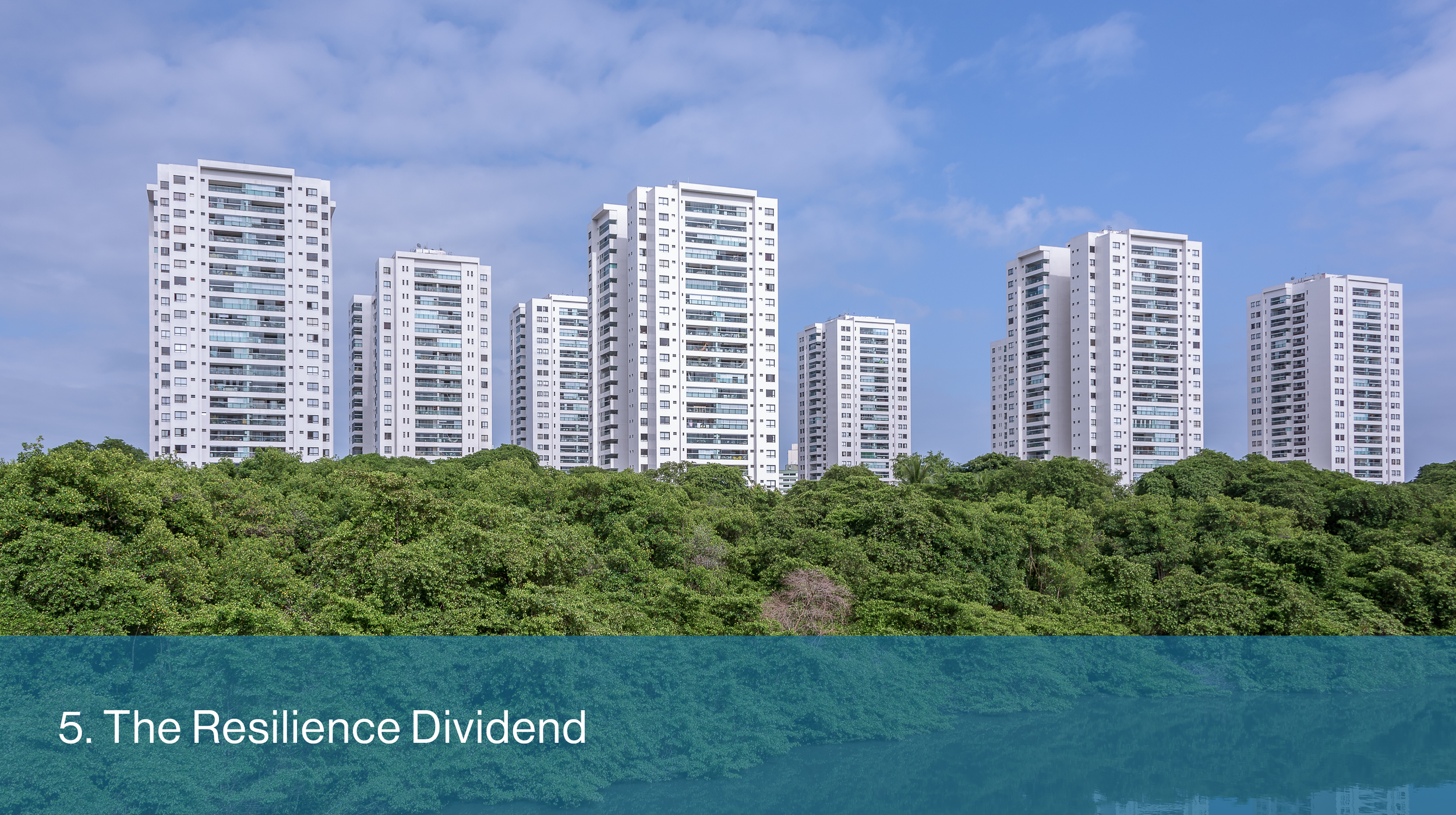
As climate impacts accelerate and associated economic losses surge, resilience has become a near-term financial consideration for real estate owners. The National Oceanic and Atmospheric Administration (NOAA) reports that U.S. billion-dollar disasters have more than quadrupled since the late 1980s.[46] JLL highlights an 88% increase in CRE insurance premiums in the past five years alone.[47] As these risks become more visible, properties in exposed areas are also seeing rising operating expenses and softening buyer demand — a cascade of pressures that can erode property values without resilience investment.[48]
JLL highlights an 88% increase in CRE insurance premiums in the past five years alone.
In the last two years, a growing set of market signals — from investors, occupiers, and consumers — indicates that resilience is now central to asset quality, valuation, and financial performance:
MSCI® (2025): An analysis of 11,000 companies shows that 55% face severe physical hazards, and that roughly 25% of portfolio value is located in high-risk areas, with storm-struck firms showing weeks of underperformance.[49]
JLL (2024): The Future of Work survey reports that by 2030, 45% of leading CRE companies plan to select only buildings that can withstand climate events, making resilience investment a baseline competitiveness requirement.[50]
Calvert® / Morgan Stanley (2025): Research finds that climate-exposed properties may face lower returns and stranded-asset risk, while resilient portfolios are positioned to outperform over time.[51]
Zillow® (December 2025): The company removed climate-risk data after finding it discouraged buyers, indicating that risk visibility is already shaping consumer behavior.[52]
Cities and public agencies are also reshaping market behavior. Local governments are embedding resilience into zoning, overlays, and permitting, increasingly requiring flood-, heat-, and storm-protective features in new projects. Public funding is expanding as well, from federal resilience grants to state programs like Strengthen Alabama Homes, which offers $10,000 grants for upgrades that simultaneously reduce insurance costs.[53][54] Public–private partnerships are also advancing resilience, including Southeast Florida’s Regional Economic Resilience Collaboration, which aims to unite governments, businesses, and nonprofits to accelerate regional projects.[55]
To ensure operational continuity and long-term value protection, portfolios will need systematic climate-risk assessments, targeted mitigation plans, and resilience criteria embedded into acquisition, CapEx planning, and asset management.
To ensure operational continuity and long-term value protection, portfolios will need systematic climate-risk assessments, targeted mitigation plans, and resilience criteria embedded into acquisition, CapEx planning, and asset management. Nature-based strategies — such as shading, bioswales, native landscaping, green roofs, and improved stormwater systems — are increasingly recognized for enhancing resilience while lowering operating costs, improving tenant experience, and protecting long-term asset value.[56][57] Electrification, when paired with batteries, on-site solar, or microgrids, further strengthens resilience by enabling buildings to operate more reliably during outages and extreme heat events.[58][59]
For owners, the implication is clear. Resilient properties will be better positioned to maintain insurability, protect financing options, and benefit from the growing resilience dividend as resilient assets outperform amid accelerating climate impacts.
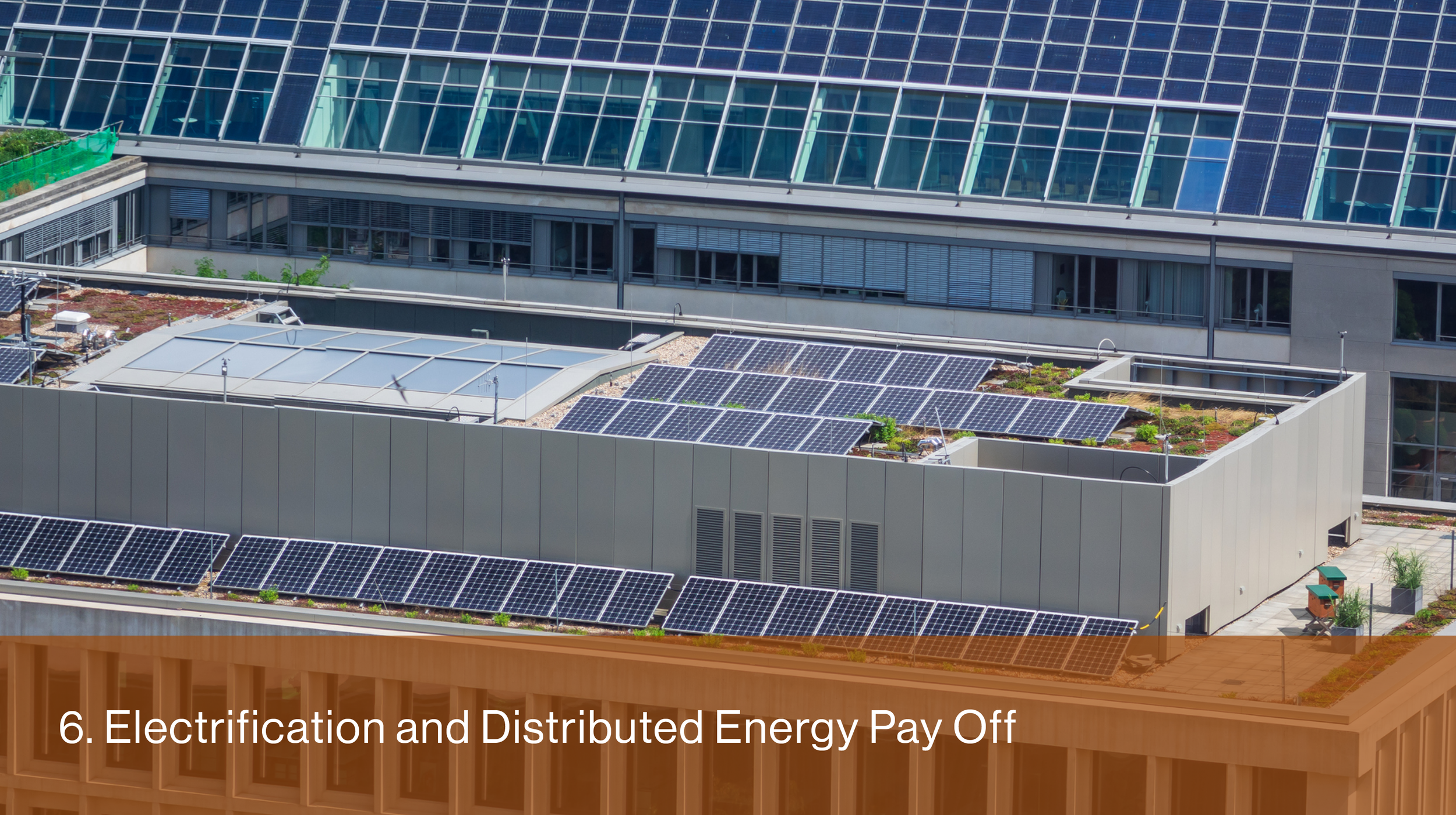
Distributed energy resources (DERs) are poised for a decisive growth phase in CRE, driven by the convergence of policy mandates, economic fundamentals, and structural constraints on the U.S. power system. As electricity demand rises and grid expansion lags, on-site generation, storage, and electrification are increasingly viewed not as optional sustainability features, but as valuable tools to manage cost, risk, and asset performance.
Policy is a primary catalyst. Building performance standards, emissions caps, and electrification mandates are embedding energy performance directly into asset economics (see Trend 3). Across major U.S. and global markets — from New York, Boston, and Washington, D.C. to California and the EU — these requirements are accelerating the obsolescence of inefficient, fossil fuel–dependent buildings (see Trend 8). As a result, energy performance is increasingly reflected in valuation, leasing, and underwriting, with high-emissions assets facing retrofit liabilities, compliance risks, and declining tenant demand.[60][61]
At the same time, the cost structure of distributed energy has shifted decisively. Solar costs fell 12% in 2024, while battery storage costs have declined by 93% since 2010. As a result, 94% of renewable power installed globally in 2024 was cheaper than the lowest-cost fossil fuel alternative.[62] For CRE owners, electrification paired with on-site generation and storage offers not only lower unit energy costs, but greater operational flexibility. Electrified systems can be actively managed to shape demand, reduce peak loads, and mitigate exposure to time-of-use pricing and demand charges — transforming energy from a fixed expense into a controllable operating variable.[63] When configured as microgrids, these systems can also operate in “island mode,” allowing buildings to disconnect from the grid and maintain critical operations during outages or price spikes, further enhancing resilience and asset value.[64]
For CRE owners, electrification paired with on-site generation and storage offers not only lower unit energy costs, but greater operational flexibility. Electrified systems can be actively managed to shape demand, reduce peak loads, and mitigate exposure to time-of-use pricing and demand charges — transforming energy from a fixed expense into a controllable operating variable.
These economics are reinforced by supply–demand constraints on the grid. U.S. electricity demand is projected to increase 25% by 2030 compared to 2023 levels, driven by electrification, AI, and data center growth.[65] Meanwhile, new natural gas generation faces multi-year turbine backlogs, and nuclear expansion remains slow and capital intensive. In contrast, solar and wind power paired with battery storage are deployable today, at the building or campus level, without reliance on new centralized generation or transmission upgrades.
Market adoption is already evident across scales. Regionally, California’s battery storage capacity has grown more than 2,100% since 2019, contributing to the near-elimination of rolling brownouts.[66] At the asset level, CRE owners are realizing measurable value: avoided grid upgrade costs, six-figure annual energy savings, improved outage resilience, and multi-million-dollar valuation uplifts driven by NOI improvement and risk reduction.[67]
Capital providers are responding accordingly. Large funding rounds — such as the $1 billion Series C raised by Base Power® — reflect growing investor confidence in behind-the-meter energy infrastructure as a durable asset class.[68] At the same time, energy-as-a-service (EaaS) models are gaining traction as a financing structure, allowing building owners to deploy on-site generation, storage, and microgrids through service contracts rather than upfront capital. The commercial EaaS market was valued at approximately $67 billion in 2025 and is projected to grow to more than $150 billion by 2035, driven by demand for flexible, cost-effective, and resilient energy solutions.[69]
Taken together, these signals point to a structural shift. For CRE, distributed energy and electrification are emerging as core components of asset strategy, enabling owners to navigate regulation, control operating costs, enhance resilience, and position portfolios for outperformance in a constrained and electrifying energy system.

The surging use of artificial intelligence (AI) is triggering an unprecedented spike in electricity demand from data centers. The International Energy Agency projects that global data center energy consumption will more than double by 2030 to 945 TWh — roughly equating to Japan’s annual electricity use. Goldman Sachs® similarly forecasts a 165% increase in data center energy demand from 2023 to 2030, driven by energy-intensive AI workloads. In the U.S., data center construction has tripled in just three years. By 2030, data centers serving AI could use more U.S. electricity than the manufacturing of steel, cement, and other energy-heavy goods combined. [70][71]
Utilities and policymakers are scrambling to keep up. Some have delayed coal plant retirements and added gas generation to meet demand, raising concerns about infrastructure investments that are misaligned with Paris Agreement pathways and vulnerable to transition risks related to the transition to clean energy. In San Jose, CA, AI data center proposals could nearly triple electricity demand to over 1,400 MW by 2035.[72] Yet interconnection remains a bottleneck — new plants and transmission infrastructure can take five to eight years to build. To address this, states like California, Virginia, and Illinois are advancing legislation requiring data centers to disclose energy and water use and shift toward renewables.[73] In overloaded regions, moratoriums on new data center approvals are being considered.[74]
Data center operators aren’t waiting. Many are securing clean power through power purchase agreements or green tariffs, with some reaching 100% renewable use. Others are exploring nuclear options to secure reliable base power — from constructing small modular reactors (SMRs) to reactivating dormant plants. To reduce load, owners are adopting liquid cooling (reducing cooling energy from ~20% to ~7%) while optimizing compute tasks. Facing long grid delays, some are co-locating with renewables or investing in on-site generation and battery storage to accelerate deployment and reduce dependence on constrained grids.[73] [74]
In today’s market, energy resilience is ROI — a critical determinant of feasibility, valuation, and risk in CRE strategy.
In today’s market, energy resilience is ROI — a critical determinant of feasibility, valuation, and risk in CRE strategy.[75] Power access has become as pivotal as location in siting and valuation decisions. Data center projects often require major infrastructure investment, from private substations and battery systems to backup generation, with developers often responsible for grid upgrades.[74] At the same time, water resilience is increasingly intertwined with energy resilience: while liquid cooling can significantly reduce energy demand, it is more water intensive, whereas air cooling conserves water but increases electricity use. This creates site-specific tradeoffs that depend on local environmental and economic conditions.[76]
For CRE, these dynamics are transforming underwriting and influencing how power is priced into leases, particularly for high-demand occupiers such as AI data centers, biotech labs, and EV fleets. Sites with reliable, redundant power supply or dedicated substations are commanding premium rents, tighter cap rates, and better lending terms. Carbon exposure and energy cost volatility are increasingly priced into underwriting, with long-term clean energy contracts and on-site systems helping to mitigate this risk by improving cost certainty and control.[74] In short, “location, location, location” is being replaced by “location, resilience, reliability,” as CRE leaders increasingly treat energy strategy as infrastructure strategy — and a prerequisite for long-term competitiveness.[75]
In short, “location, location, location” is being replaced by “location, resilience, reliability,” as CRE leaders increasingly treat energy strategy as infrastructure strategy — and a prerequisite for long-term competitiveness.

U.S. climate policy leadership has shifted decisively to cities and states over the past year, following the suspension of the U.S. Securities and Exchange Commission (SEC)’s 2024 climate disclosure rules and the rollback of federal clean-energy incentives under the One Big Beautiful Bill Act.[77][78] In the absence of consistent federal direction, state and local governments are now setting the regulatory baseline for climate action in CRE.
California’s climate disclosure laws illustrate this shift. SB 253 will require U.S. companies operating in the state to disclose scope 1 and scope 2 GHG emissions beginning in 2026, with scope 3 disclosures to follow in 2027. SB 261 was set to require climate-related financial risk disclosures starting January 1, 2026, but a recent injunction paused enforcement, pending the outcome of litigation (arguments begin January 9, 2026). Other states — including New York, New Jersey, Colorado, and Illinois — are pursuing similar climate disclosure legislation, signaling that California’s approach is likely to shape a broader, state-led regulatory trend.[79]
California’s climate disclosure laws illustrate this shift. SB 253 will require U.S. companies operating in the state to disclose scope 1 and scope 2 GHG emissions beginning in 2026, with scope 3 disclosures to follow in 2027.
At the same time, building performance standards (BPS) are advancing rapidly at the city and state levels, mandating reductions in emissions and energy use across existing commercial buildings. Regulations are already in effect in jurisdictions such as New York City, Boston, St. Louis, and Washington, with a dozen additional cities and states requiring compliance by 2030.
BPS enforcement is no longer theoretical. In 2025, New York City issued its first penalties (for the 2024 calendar year) under Local Law 97 — $268 per metric ton of emissions above the limit — while allowing some owners to submit decarbonization plans to reduce fines. As of October 2025, the city reports that about 94% of covered buildings filed the documentation required to comply, signaling high engagement and underscoring BPS as a material transition risk.[80][81]
However, a 2025 Center for an Urban Future report on Local Law 97 indicates that current Local Law 97 penalty levels are likely insufficient to motivate major building upgrades, particularly for larger property owners facing high retrofit costs. As one senior real estate official told researchers, “To eliminate the fines, we’d have to invest 15 to 20 times the fine amount. So, like other owners, we’ll probably pay the fine.” The report suggests that to effectively spur action, policymakers will need to reassess penalty levels and the role of renewable energy credits, while structuring city, state, and utility incentive programs to make compliance the rational economic choice, a conclusion echoed by other recent analyses of BPS in other U.S. jurisdictions. [82][83][84]
Together, these policies are creating a fragmented, bottom-up regulatory landscape that complicates compliance for nationwide portfolios. For building owners, this makes aligning with widely recognized frameworks is a strategic necessity. LEED® v5, the GHG Protocol®, Science Based Targets® initiative, Carbon Risk Real Estate Monitor (CRREM®), Task Force on Climate-Related Financial Disclosures, and IFRS S1/S2 help bring consistency to data, align with investor expectations, and support long-term portfolio positioning. In this environment, owners increasingly view assets aligned with local climate laws as lower-risk and better positioned, while voluntary standards and certifications play a growing role in differentiation and maintaining stakeholder trust amid regulatory change.[85]

Investor scrutiny is moving beyond carbon, with nature and biodiversity data emerging as a core ESG priority. Investors are increasingly demanding verified, asset-level biodiversity data to understand exposure to ecosystem risks, dependencies, and potential impacts on long-term asset performance.[86][87] Tenant demand is reinforcing this trend, as buildings with strong environmental and nature-aligned credentials achieve approximately 7–12% rent premiums globally, while less sustainable assets face lower rents, weaker demand, and value erosion.[88]
Tenant demand is reinforcing this trend, as buildings with strong environmental and nature-aligned credentials achieve approximately 7–12% rent premiums globally, while less sustainable assets face lower rents, weaker demand, and value erosion.
Access to decision-useful nature data remains a key constraint, with many investors still lacking sufficient and comparable biodiversity information to effectively assess nature-related risks and dependencies. This challenge is now shaping the focus of emerging disclosure frameworks and market initiatives aimed at improving the consistency, comparability, and the usability of nature data.[89]
Demand is being matched by the rapid rollout of global nature-related disclosure frameworks. The Taskforce on Nature-Related Financial Disclosures (TNFD) provides a structure around governance, strategy, risk management, and metrics and targets, asking organizations to report on their dependencies, impacts, risks, and opportunities.[90] The International Sustainability Standards Board (ISSB®) (creator of IFRS S1/S2) has confirmed it will build on the TNFD framework to develop formal nature-related disclosure requirements within its global sustainability standards, helping ensure consistent, investor-relevant reporting on nature.[91] Similarly, the recently released standard ISO® 17298, focused on biodiversity, offers practical guidance for embedding biodiversity into strategy and operations.[92] Together, these frameworks standardize reporting on ecosystem dependencies and impacts, helping investors and tenants identify and reward nature-positive assets through capital, incentives, or leasing preference.
Building on this shift toward standardized, decision-useful biodiversity data, COP30 in Brazil reinforced nature and forests as central pillars of global climate action. Outcomes from the summit placed strong emphasis on halting deforestation, scaling finance for forest conservation, and recognizing the role of Indigenous land stewardship in delivering climate and biodiversity outcomes.[93][94] Brazil is championing a new financing instrument to directly reward conservation, called the Tropical Forests Forever Facility (TFFF). By channeling approximately $4 billion per year to forest preservation, including funds earmarked for Indigenous stewardship, the TFFF highlights how nature-positive outcomes are increasingly linked to financial flows, signaling that assets aligned with these outcomes can access green finance and market incentives.[95]
Taken together, rising investor and tenant demand, rapidly maturing disclosure frameworks, and global policy momentum signal that nature and biodiversity are becoming core drivers of asset valuation and capital allocation. As standardized, decision-useful nature data improves, assets that can demonstrate credible, nature-positive outcomes will be better positioned to manage risk, attract capital, access incentives, and maintain long-term competitiveness.

Strategic sustainability messaging has become a critical business function in the current era of corporate sustainability. Shifting federal policy priorities, heightened U.S.-centric backlash to ESG, rising greenwashing enforcement, and a more capital-constrained economic environment have significantly raised the stakes for how companies talk about sustainability.[96][97]
In 2025, more companies began to reassess their sustainability communications following the change in U.S. administration, accelerating a trend that started around 2023. Some companies have simply moved away from highly visible ESG or DEI language, while others have adopted greenhushing or “strategic silence” — reducing public-facing sustainability rhetoric while continuing execution internally.[98] An analysis by The Conference Board® found that the share of S&P 100 sustainability reports with “ESG” in the title fell from 40% in 2023 to 25% in 2024, and only 6% of reports published as of April 11, 2025, used the term.[99] This shift is most pronounced in the U.S., amid escalated political and regulatory scrutiny, while companies in Europe and Asia Pacific generally have faced less pressure to scale back external communication.
Importantly, quieter communication has largely not coincided with reduced commitment:
A 2025 UN Global Compact–Accenture® survey of more than 2,000 CEOs across 128 countries found that 99% of chief executives intend to maintain or expand their ESG commitments, while only about 50% report feeling comfortable communicating progress publicly.[100]
Another survey of 75 global firms conducted by a Harvard researcher and an independent consultant in September 2025 found that while 85% maintained or expanded sustainability programs in the last year, only 16% publicly reaffirmed doing so.[101]
EcoVadis® reported in August 2025 that 87% of 400 U.S. executives surveyed had maintained or increased sustainability investments since the start of 2025.[102]
This data indicates that execution continues, even as external messaging becomes more cautious.
Overall, sustainability communication is shifting toward more evidence-based and business-aligned narratives. A May 2025 survey by The Conference Board found that 43% of U.S. sustainability executives now emphasize ROI and shareholder value when communicating ESG initiatives, reflecting strategic recalibration and a maturing field.[103] Once aspirational and marketing-led, sustainability messaging is now expected to demonstrate implementation and results as it becomes embedded across finance, risk management, and operations. Morgan Stanley’s 2025 Sustainable Signals survey results reinforce this shift, reporting that 88% of sustainability decision makers at 300 companies view sustainability as a long-term value driver, and more than 80% can measure returns on sustainability investments. This shift makes it both possible and necessary to communicate sustainability progress using the same evidence-based language applied to other capital decisions.[104]
Once aspirational and marketing-led, sustainability messaging is now expected to demonstrate implementation and results as it becomes embedded across finance, risk management, and operations.
Investors have shown a similar pattern — publicly stepping back from highly visible climate initiatives such as the Net Zero Asset Managers (NZAM) initiative, while remaining engaged behind the scenes.[105] As ESG shareholder proposals declined in 2024–2025, engagement has shifted to private dialogue focused on how sustainability efforts reduce risk, protect value, and support long-term performance.[98] Climate risk remains central: a 2024 Stanford–MSCI survey found that 93% of institutional investors ranked climate issues as most likely to impact financial performance within two to five years, reinforcing sustainability as a core fiduciary consideration.[106][107]
Increasingly stringent enforcement and litigation to discourage greenwashing further elevates the importance of getting the message right. In Europe, a recent German court ruling blocked Apple® from marketing its Apple Watch® as “carbon neutral,” finding that the claim was insufficiently substantiated and prompting the company to remove similar language from product marketing.[108] In the U.S., companies are also facing a growing number of legal challenges to environmental claims, underscoring that sustainability communication must now withstand regulatory and legal scrutiny.[109]
The result is a new communications standard: proof-ready sustainability storytelling. Sustainability communication now extends beyond marketing, serving as a visible expression of ESG governance that signals how rigorously sustainability is measured, overseen, and embedded in decision making. Best practice now emphasizes material issues, verified data, recognized reporting frameworks, and alignment with business strategy, alongside transparency about progress and gaps. In this environment, rather than visibility, successful sustainability narratives are defined by credibility, discipline, and proof of performance.
Conclusion
Although 2025 was a challenging year, the overall direction of corporate sustainability — especially in CRE — remains unchanged. At the global level, climate risks, sustainability regulations, and performance expectations are increasingly shaping how capital is allocated across markets. Jurisdictions with clear climate rules and long-term policy certainty are attracting investment, while extreme weather, grid constraints, and rising electricity demand are elevating resilience and energy access as foundational strategic considerations.
At the asset level, building performance standards and investor benchmarks like GRESB are now central to capital planning, while decisions around resilience, electrification, distributed energy resources, and nature shape how buildings operate day to day — affecting operating costs, tenant experience, maintenance needs, and the feasibility of meeting performance requirements over time. Sustainability data is also increasingly expected to meet financial-grade standards, requiring owners to build asset-level sustainability data infrastructure that supports portfolio-wide coverage, quality, and auditability.
Looking ahead to 2026, economic and policy uncertainty may persist, but the acceleration of climate risks makes urgent action essential. As the financial performance of sustainability investments become clearer and more consistently measured, the era in which sustainability was treated as a standalone initiative or a marketing exercise is ending. As it continues to prove itself as a driver of value, sustainability is increasingly embedded in core business and investment decision-making, shaping how CRE companies manage risk and compete over the long term.
How Verdani Can Help
Verdani helps commercial real estate owners move from sustainability commitments to verified performance — building the systems, financial-grade data, decarbonization and resilience strategies, and sustainability communications necessary to meet regulatory demands, reduce risk, and protect long-term asset value. To learn more about our services, visit https://verdani.com/esg-sustainability-services/
Authors

Carli Schoenleber
SENIOR COMMUNICATIONS MANAGER (CONTENT AND ENGAGEMENT SPECIALIST)Carli is a Senior Communications Manager at Verdani Partners, where she leads thought leadership, chairs the Engagement Committee, and serves as primary author for Verdani's nonprofit, the Verdani Institute for the Built Environment. With over a decade of experience in the sustainability field, she bridges research and communications to translate complex issues into persuasive messaging and actionable strategies that drive business value and positive impact. Carli holds a B.S. in Environmental Science, Policy, and Management from the University of Minnesota and an M.S. in Forest Ecosystems and Society from Oregon State University.

PAULYNN CUE
CHIEF COMMUNICATIONS & BUSINESS OFFICERPaulynn is the Chief Communications Officer for Verdani Partners, bringing over 20 years of experience in sustainability and ESG, business development, communications, design, and regenerative development. She has been instrumental in shaping Verdani’s programs since 2014. Paulynn studied architecture at Carnegie Mellon University, advertising at New York University, and environmental design at Parson’s School of Design, and has worked with leading organizations such as Gensler, World Building Institute, and the Intergovernmental Renewable Energy Organization Sustainable Development Commission.

GABE JOHN
SENIOR COMMUNICATIONS MANAGERGabe is a Senior Communications Manager specializing in corporate communications, organizational management, and partnership development. He has 10+ years of professional writing and program management experience, working in the areas of education, conservation, and the built environment. Verdani Partners leverages Gabe’s writing expertise to execute client annual reports and stakeholder engagement. He holds a B.S. in Environmental Science & Management from the University of California, Davis and is an AWAI-certified copywriter.

Vanessa Vlasak
ASSOCIATE SUSTAINABILITY MANAGERVanessa is an Associate Sustainability Manager at Verdani Partners, supporting one of Verdani’s largest clients in advancing their sustainability program. She has over four years of experience in green real estate and clean energy and is passionate about driving meaningful sustainability initiatives in the commercial real estate sector. Additionally, she contributes to the development of biodiversity services and serves as Co-Chair for Verdani’s Regulatory Committee. Vanessa holds a B.S. in Environmental and Ocean Sciences from the University of San Diego.
References
[1] Net Zero Tracker (2025, September 22). Net Zero Stocktake 2025. https://zerotracker.net/analysis/net-zero-stocktake-2025
[2] United Nations Environment Programme (2025). Global status report for buildings and construction 2024/25. https://globalabc.org/sites/default/files/2025-03/Global-Status-Report-2024_2025.pdf
[3] Glasser, M. & Peck, D. (2025, November 9). What to know about COP30 as the international climate conference gets underway in Brazil. ABC News. https://abcnews.go.com/US/cop30-international-climate-conference-gets-underway-brazil/story?id=127256517#:~:text=When%20will%20COP30%20take%20place,extend%20beyond%20the%20official%20schedule.
[4] Pyke, C. (2025, January 27). What does a GRESB Score mean? GRESB. https://www.gresb.com/nl-en/gresb-scoring-insights-what-does-a-gresb-score-mean/
[5] Gonzalez, T.A., et al. (2025, January). Green gains: The impact of REITs’ environmental performance on sustainability-linked loan interest rates. Finance Research Letters. https://www.sciencedirect.com/science/article/pii/S1544612324014442
[6] GRESB (2025). Sustainability-linked loans. https://www.gresb.com/nl-en/sustainability-linked-loans/
[7] CBRE (2025, June). European lender intentions survey 2025. https://mediaassets.cbre.com/-/media/project/cbre/shared-site/insights/reports/european-lender-intentions-survey-2025.pdf?rev=3ee587cd2c834ddf949469c928c68521
[8] Flowers, S. & Martin, P. (2024, June 11). How higher interest rates could hold up energy transition investment. World Economic Forum. https://www.weforum.org/stories/2024/06/energy-transition-investment-interest-rates/
[9] Schoenleber, C., et al. (2025, November 5). Pathways to portfolio-level decarbonization. Verdani Institute for the Built Environment. https://www.verdani-institute.org/global-decarbonization-guidance-report
[10] C-PACE Alliance (n.d.). What is C-PACE financing? https://c-pacealliance.org/
[11] CLA. (n.d.). Transferable energy credits remain a key strategy after OBBBA. https://www.claconnect.com/en/resources/articles/25/transferable-energy-credits-remain-a-key-strategy-after-obbba
[12] Rubin, H. (2025, December 5). Real estate decarbonization is moving to the building level. Trellis. https://trellis.net/article/real-estate-decarbonization-expanding-building-level/
[13] JLL. (November 2025). City Policy is Driving Building Transformation. https://www.jll.com/en-us/insights/city-policy-is-driving-building-transformation
[14] Royal Bank of Canada (RBC). (August 2025). Carbon Pricing & Competitiveness: Steering Canada’s Climate Policies Amid Trade Shocks. https://www.rbc.com/en/thought-leadership/climate-action-institute/energy-reports/carbon-pricing-competitiveness-steering-canadas-climate-policies-amid-trade-shocks/
[15] OECD. (2025). Investing in Climate for Growth and Development The Case for Enhanced NDCs. https://www.oecd.org/content/dam/oecd/en/publications/reports/2025/06/investing-in-climate-for-growth-and-development_9ce9b093/16b7cbc7-en.pdf
[16] The American Bazaar. (December 2025). Why the Next Commercial Real Estate Crisis Will Be Performance-Driven, Not Interest-Rate Driven. https://americanbazaaronline.com/2025/12/13/commercial-real-estate-crisis-performance-interest-rate-driven-471580/
[17] PWC. (2025). Emerging Trends in Real Estate® 2026. Emerging Trends in Canadian Real Estate. A New Playbook for Dealmaking. https://www.pwc.com/us/en/industries/financial-services/asset-wealth-management/real-estate/emerging-trends-in-real-estate-pwc-uli/canada/canada-dealmaking.html
[18] ESG Dive. (May 2024). Anti-ESG Laws Hurting Texas Economically, Unpopular With Voters: Research. https://www.esgdive.com/news/anti-esg-laws-hurting-texas-economically-unpopular-with-votersuaf/716741/
[19] Calvert. (March 2025). Climate Risks Lead to New Capital Strategies in Commercial Real Estate. https://www.morganstanley.com/im/publication/insights/articles/article_climaterisksleadtonewcapitalstrategies_a4.pdf
[20] Calvert. (March 2025). Climate Risks Lead to New Capital Strategies in Commercial Real Estate. https://www.morganstanley.com/im/publication/insights/articles/article_climaterisksleadtonewcapitalstrategies_a4.pdf
[21] European Commission (2025, November 6). European Union endorses Leaders Declaration on Carbon Markets forged with Brazil at COP30 in Belém. https://ec.europa.eu/commission/presscorner/detail/en/ip_25_2638
[22] Zacharia, M. (2025, October 27). CBAM: A guide to Carbon Border Adjustment Mechanism. One Click LCA. https://oneclicklca.com/en/resources/articles/cbam-a-guide-to-carbon-border-adjustment-mechanism
[23] FCLTGlobal (2025, July). Ahead of the curve: Factoring the cost of carbon into long-term decision-making. https://www.fcltglobal.org/wp-content/uploads/Ahead-of-the-Curve-FCLTGlobal.pdf
[24] Calvert. (March 2025). Climate Risks Lead to New Capital Strategies in Commercial Real Estate. https://www.morganstanley.com/im/publication/insights/articles/article_climaterisksleadtonewcapitalstrategies_a4.pdf
[25] Knight Frank (2023). Sustainability series: ESG property investor survey. https://content.knightfrank.com/research/2740/documents/en/sustainability-series-esg-property-investor-survey-10532.pdf
[26] Urban Green (2025). What is local law 97? https://www.urbangreencouncil.org/what-we-do/driving-innovative-policy/ll97/
[27] EVORA (2025, February 25). What will Local Law 97 mean for residential real estate in NYC? https://www.gresb.com/nl-en/what-will-local-law-97-mean-for-residential-real-estate-in-nyc/
[28] Schoenleber, C. & Cue, P. (2025, November). The clock is ticking: Are you ready for California’s climate rules? GRESB Insights. https://www.gresb.com/nl-en/the-clock-is-ticking-are-you-ready-for-californias-climate-rules/
[29] United Nations Environment Programme (2025). Global status report for buildings and construction 2024/25. https://globalabc.org/sites/default/files/2025-03/Global-Status-Report-2024_2025.pdf
[30] Avery, C. (2024, April 16). Brown discounts, not green premiums, are driving real estate sustainability, say managers. New Private Markets. https://www.newprivatemarkets.com/brown-discounts-not-green-premiums-are-driving-real-estate-sustainability-say-managers/
[31] Santiago, C. (2021, June 2). DBS extends first sustainability-linked loans to SK Telecom, Keppel Land. The Asset 25. https://www.theasset.com/treasury/43795/dbs-extends-first-sustainability-linked-loans-to-sk-telecom-keppel-land
[32] Keppel (2024). Sustainability framework. https://www.keppel.com/annualreport2023/sustainability-framework/
[33] Thirugnansambandan, R., et al. (2024, December 16). Transitioning from the Task Force on Climate-Related Financial Disclosures (TCFD) to the IFRS Sustainability Disclosure Standards. Verdani Partners. https://verdani.com/sustainability-industry-insights/transitioning-from-the-task-force-on-climate-related-financial-disclosures-tcfd-to-the-ifrs-sustainability-disclosure-standards
[34] ICAEW (2025). CSRD: Sustainability assurance. https://www.icaew.com/groups-and-networks/local-groups-and-societies/europe/european-sustainability-reporting-and-assurance/csrd-sustainability-assurance?
[35] EFRAG (n.d.). Digital reporting with XBRL. https://www.efrag.org/en/sustainability-reporting/esrs-workstreams/digital-reporting-with-xbrl
[36] G&A Institute & DFIN (2025). XBRL Digital tagging for CSRD & ESRS: How companies can meet the EU’s new digital reporting requirements. https://www.dfinsolutions.com/sites/default/files/documents/2025-09/DFIN%20-%20G%26A%20-%20%20ESG%20Whitepaper.pdf
[37] Shannon, M. (2024, February 28). Limited vs reasonable assurance over ESG. KPMG. https://kpmg.com/xx/en/our-insights/esg/limited-vs-reasonable-assurance-over-esg.html
[38] CDP (2024). Frequently asked questions: Verification. https://cdn.cdp.net/cdp-production/comfy/cms/files/files/000/009/214/original/CDP_Verification_FAQ_Document.pdf
[39] GRESB (2025). GRESB Real Estate Assessment. https://www.gresb.com/nl-en/real-estate-assessment/
[40] PwC (2024). PwC’s global investor survey 2024. https://www.pwc.com/gx/en/issues/c-suite-insights/global-investor-survey/global-investor-survey-report-2024.pdf
[41] EDM Council (2024, April). Playbook for effective ESG and sustainability data management. https://edmcouncil.org/wp-content/uploads/2024/04/EDM-Council_Playbook_ESG-and-Sustainability-Data-Mgmt_April-2024.pdf
[42] Alnaser, A.A., et al. (2024). AI-powered digital twins and internet of things for smart cities and sustainable built environment. MDPI. https://www.mdpi.com/2076-3417/14/24/12056
[43] Construction Products Europe (n.d.). Digital building logbook. https://www.construction-products.eu/publications/digital-building-logbook/
[44] Circular Buildings Coalition (2025, March 6). The building passport alignment project: Enabling seamless ESG reporting for real estate. https://www.circularbuildingscoalition.org/latest/the-building-passport-alignment-project-enabling-seamless-esg-reporting-for-real-estate
[45] Schoenleber, C. (2025, June 10). ENERGY STAR Portfolio Manager may be phased out: What CRE teams should do now. Verdani Partners. https://verdani.com/sustainability-industry-insights/energy-star-portfolio-manager-may-be-phased-out-what-cre-teams-should-do-now
[46] Climate Central (2025, October 21). Now at Climate Central: U.S. billion-dollar weather and climate disasters. UNDRR PreventionWeb. https://www.preventionweb.net/news/now-climate-central-us-billion-dollar-weather-and-climate-disasters
[47] Nicholson, R. (n.d.). How climate risks are impacting real estate insurance costs. JLL. https://www.jll.com/en-us/insights/how-climate-risks-are-impacting-real-estate-insurance-costs
[48] Tostevin, P. (2025, March). Adaptation or obsolescence: Real estate on the front line of climate change. Savills. https://impacts.savills.com/market-trends/adaptation-or-obsolescence-real-estate-on-the-front-line-of-climate-change.html#:~:text=But%20it%20brings%20opportunity%2C%20too,to%20residents%2C%20businesses%2C%20and%20visitors
[49] MSCI (2025, November 3). Hidden in plain sight: Physical risk in asset owners’ portfolios. https://www.msci.com/downloads/web/msci-com/research-and-insights/paper/hidden-in-plain-sight-physical-risk-in-asset-owners-portfolios/Hidden%20in%20Plain%20Sight%20-%20Physical%20Risk%20in%20Asset%20Owners'%20Portfolios%20-%20FINAL.pdf
[50] Markiewicz, K. (n.d.). From climate risk to climate resilience. JLL. https://www.jll.com/en-ae/insights/from-climate-risk-to-climate-resilience
[51] Calvert (2025, March). Climate risks lead to new capital strategies in commercial real estate. https://www.morganstanley.com/im/publication/insights/articles/article_climaterisksleadtonewcapitalstrategies_ltr.pdf#:~:text=revenue%20opportunities%2C%20like%20timber%20REITs,and%20internationally%2C%20in%20coming%20years
[52] Nilsen, E. (2025, December 2). The real estate industry is pressuring Zillow and other sites to nix extreme weather risk data buyers have ocme to rely on. CNN Climate. https://www.cnn.com/2025/12/02/climate/zillow-climate-data-extreme-weather-first-street-redfin
[53] FEMA (2025). FEMA Grants. https://www.fema.gov/grants
[54] Fortified (2025). Alabama Understood… https://fortifiedhome.org/incentives-alabama/
[55] Southeast Florida Regional Climate Change Compact (n.d.). Partners. https://southeastfloridaclimatecompact.org/partners/
[56] Schoenleber, C., et al. (2025, March 18). Special report: Nature-based practices for pollinators and CRE in North America. Verdani Partners. https://verdani.com/sustainability-industry-insights/nature-based-practices-for-pollinators-and-commercial-real-estate-in-north-america
[57] Vicarelli, M., et al. (2024, October). On the cost-effectiveness of nature-based solutions for reducing disaster risk. Science of the Total Environment. https://www.sciencedirect.com/science/article/abs/pii/S0048969724046722?via%3Dihub
[58] Better Buildings U.S. Department of Energy (n.d.). Solar + energy storage 101. https://dg.resilienceguide.ornl.gov/solar
[59] National Laboratory of the Rockies (2025, May 7). Microgrids could enhance grid resilience. https://www.nrel.gov/news/detail/program/2025/microgrids-could-enhance-grid-resilience
[60] INREV (2025, April). Integrating environmental considerations in real estate underwriting. https://www.inrev.org/system/files/2025-04/INREV-Integrating-environmental-considerations-in-real-estate-underwriting_1.pdf
[61] Burns, J. (2025, September 25). Owner-tenant green retrofit investment boosts value: JLL. Facilities Dive. https://www.facilitiesdive.com/news/owner-tenant-green-retrofit-investment-boosts-value-jll/761131/
[62] Outrage + Optimism. (2025). Inside COP: The final hours of COP30 — and the road ahead [Audio podcast episode]. Outrage + Optimism. https://www.outrageandoptimism.org/episodes/inside-cop-the-final-hours-of-cop30-and-the-road-ahead?hsLang=en
[63] Willige, A. (2025, October 2). What is energy flexibility and how can it help meet rapidly rising energy demand? World Economic Forum. https://www.weforum.org/stories/2025/10/energy-flexibility-and-demand-response/
[64] Kamal, A. (2025, March 8). Why islanding is the secret to resilient energy systems? ElectricFish. https://electricfish.co/islanding-in-microgrids/
[65] ICF. (2025, June 9). Fast forward: Electricity demand expected to grow 25% by 2030. Retrieved at https://www.icf.com/insights/energy/electricity-demand-expected-to-grow
[66] California Energy Commission. (2025, November 13). California’s battery storage fleet continues record growth, strengthening grid. Retrieved at https://www.energy.ca.gov/news/2025-11/californias-battery-storage-fleet-continues-record-growth-strengthening-grid
[67] Veckta. (2024, October 21). The future of solar for commercial buildings. Retrieved at https://veckta.com/2024/10/21/solar-for-commercial-buildings/#:~:text=As%20VECKTA%E2%80%99s%20CEO%2C%20Gareth%20Evans%2C,solar%20installation%20and%20battery%20storage
[68] Hawker, E. (2025, October 10). Home energy storage startup base power raises $1 billion. ESG Today. https://www.esgtoday.com/home-energy-storage-startup-base-power-raises-1-billion/
[69] Future Market Insights (2025, September 5). Commercial energy as a service (EaaS) market. https://www.futuremarketinsights.com/reports/commercial-energy-as-a-service-eaas-market
[70] International Energy Agency (2025, April 10). AI is set to drive surging electricity demand from data centres while offering the potential to transform how the energy sector works. https://www.iea.org/news/ai-is-set-to-drive-surging-electricity-demand-from-data-centres-while-offering-the-potential-to-transform-how-the-energy-sector-works
[71] Goldman Sachs (2025, August 29). How AI is transforming data centers and ramping up power demand. https://www.goldmansachs.com/insights/articles/how-ai-is-transforming-data-centers-and-ramping-up-power-demand
[72] Lazo, A. (2025, December 8). Data centers for AI could nearly triple San Jose’s energy use. Who foots the bill? Cal Matters. https://calmatters.org/environment/2025/12/data-center-energy-san-jose/
[73] Leppert, R. (2025, October 24). What we know about energy use at U.S. data centers amid the AI boom. Pew Research Center. https://www.pewresearch.org/short-reads/2025/10/24/what-we-know-about-energy-use-at-us-data-centers-amid-the-ai-boom/
[74] Numata, Y., et al. (2025, July 17). Fast, flexible solutions for data centers. Rocky Mountain Institute. https://rmi.org/fast-flexible-solutions-for-data-centers/
[75] Coldwell Banker Commercial (2025, December 3). Why energy resilience is the new site-selection criterion in CRE. https://www.cbcworldwide.com/blog/powering-value-why-energy-resilience-is-the-new-site-selection-criterion-in-cre
[76] MSCI (2025). When AI meets water scarcity: Data centers in a thirsty world. https://www.msci.com/research-and-insights/blog-post/when-ai-meets-water-scarcity-data-centers-in-a-thirsty-world
[77] U.S. Securities and Exchange Commission (2025, March 27). SEC votes to end defense of climate disclosure rules. https://www.sec.gov/newsroom/press-releases/2025-58
[78] Schoenleber, C. (2025, August 6). Impact of the One Big Beautiful Bill Act (OBBBA) on federal sustainability incentives and the energy economy. Verdani Partners. https://verdani.com/sustainability-industry-insights/impact-of-the-one-big-beautiful-bill-act-obbba-on-federal-sustainability-incentives-and-the-energy-economynbsp
[79] Garden, L. (2025, March 20). These states are picking up the corporate climate disclosures slack. Trellis. https://trellis.net/article/these-states-are-picking-up-the-corporate-climate-disclosures-slack/
[80] Schoenleber, C., et al. (2024, September 5). The rise of sustainable building ordinances: Benchmarking, audits and retro-commissioning, and building performance standards. https://verdani.com/sustainability-industry-insights/the-rise-of-sustainable-building-ordinances-benchmarking-audits-and-retro-commissioning-and-building-performance-standards
[81] Nemo, L. (2025). Most NYC buildings have begun Local Law 97 emissions compliance. Engineering News-Record. https://www.enr.com/articles/61653-most-nyc-buildings-have-begun-local-law-97-emissions-compliance
[82] Center for an Urban Future (2025). New York City’s green economy opportunity. https://nycfuture.org/pdf/CUF_GreenEconomy_Report_10c.pdf
[83] Duer-Balkind, M., et al. (2024, August). Lessons from the ground: Implementing building performance standards. Institute for Market Transformation. https://imt.org/wp-content/uploads/2024/07/Lessons-from-the-Ground.pdf
[84] Taylor, L., et al. (2025, July 4). Analysis of the financial impacts of building performance standard penalties on commercial buildings in Aurora, Colorado. Environmental Systems and Decisions. https://docs.nrel.gov/docs/fy25osti/89909.pdf
[85] JLL (n.d.) The next frontier for green building certifications. https://www.jll.com/en-us/insights/the-next-frontier-for-green-building-certifications
[86] ESG Investing (2025). NatureMetrics raises $25 million to scale biodiversity monitoring and reporting program. https://esg-investing.com/2025/01/14/naturemetrics-raises-25-million-to-scale-biodiversity-monitoring-and-reporting-platform/
[87] Dohle, M. (2025, April 30). How investors turn biodiversity data into investment decisions. Net Zero Investor. https://www.netzeroinvestor.net/news-and-views/bringing-nature-into-focus-how-investors-use-data-to-track-biodiversity-risks
[88] JLL (n.d.) The next frontier for green building certifications. https://www.jll.com/en-us/insights/the-next-frontier-for-green-building-certifications
[89] Jeng, R. (2025, November 12). Integrating nature into finance: Key challenges facing the financial sector. Morningstar Sustainalytics. https://www.sustainalytics.com/esg-research/resource/investors-esg-blog/integrating-nature-into-finance--key-challenges-facing-the-financial-sector?
[90] TNFD (n.d.). Disclosure recommendations. https://tnfd.global/recommendations/
[91] IFRS (2025, November 7). ISSB welcomes TNFD’s support as it advances nature-related disclosures. https://www.ifrs.org/news-and-events/news/2025/11/issb-welcomes-tnfd-support-nature-related-disclosure/
[92] ISO (2025). ISO 17298:2025 Biodiversity – Considering biodiversity in the strategy and operations of organizations – Requirements and guidelines. Edition 1. https://www.iso.org/standard/17298
[93] United Nations Climate Change (2025). UN Climate Change Conference — Belém, November 2025. https://unfccc.int/cop30
[94] Collaborative Partnership on Forests. (2025). Joint call to action for forests toward 2030. https://www.fao.org/collaborative-partnership-on-forests
[95] Gutierrez, Y. (2025). 10 key themes Brazil is placing at the core of the COP30 agenda. Forest News. https://www.forestsnews.org/93254/brazil-cop30-agenda-key-themes#:~:text=Central%20to%20Brazil%E2%80%99s%20climate%20finance,Indigenous%20Peoples%20and%20local%20communities
[96] Ioannou, I. (2025, March 31). What the ESG backlash reveals. London Business School. https://www.london.edu/think/what-the-esg-backlash-reveals
[97] Schoenleber, C., Cue, P., & Reames, M. (2025, May 19). Special report: Strategic messaging in a high-stakes landscape, part 1: ESG, sustainability, and climate. Verdani Partners. https://verdani.com/sustainability-industry-insights/verdani-partners-strategic-messaging-in-a-high-stakes-landscape-part-1-esg-sustainability-and-climate
[98] Giles, J. (2025, December 11). Why 2025 was the year of greenhushing. Trellis. https://trellis.net/article/why-2025-was-the-year-of-greenhushing/?mkt_tok=MjExLU5KWS0xNjUAAAGewG13WbC-jAgpcEtlIgYja9DS9rqp8FpUrWSn7nr-1nCX--4Gt1v80vNW5sTOHdW5omzJyYGuIAX_r_-MO1c5GnMbrolrTvijIwjrRXSmjBThDxPVDyCW88j8sQ
[99] The Conference Board (2025, April 29). Last year, just 25% of big companies used “ESG” in their report titles. The slowdown continues in 2025… https://www.prnewswire.com/news-releases/last-year-just-25-of-big-companies-used-esg-in-their-report-titles-the-slowdown-continues-in-2025-302441386.html
[100] Eastwood, S., et al. (2025, October 21). The next era of sustainability leadership: CEO survey shows the business case is now. Harvard Law School Forum on Corporate Governance. https://corpgov.law.harvard.edu/2025/10/21/the-next-era-of-sustainability-leadership-ceo-survey-shows-the-business-case-is-now/#:~:text=derived%20from%20external%20stakeholder%20scrutiny%2C,next%20era%20of%20sustainability%20leadership
[101] Hawkins, N. & Cooper, K. (2025, September 23). Are companies actually scaling back their climate commitments? Havard Business Review. https://hbr.org/2025/09/are-companies-actually-scaling-back-their-climate-commitments
[102] EcoVadis (2025, August 26). What EcoVadis data reveals about the sustainability performance of more than 10,000 US companies. https://ecovadis.com/blog/what-ecovadis-data-reveals-about-the-sustainability-performance-of-more-than-10-000-us-companies/
[103] The Conference Board (2025, May 29). Survey: 80% of corporations are reworking ESG strategies amid policy shifts. https://www.conference-board.org/press/sustainability-under-scrutiny-2025#:~:text=80,%E2%80%9D
[104] Morgan Stanley (2025, June 30). Companies see sustainability as a way to create value. Institute for Sustainable Investing. https://www.morganstanley.com/insights/articles/corporate-sustainability-signals-report-2025#:~:text=Jun%2030%2C%202025
[105] Schoenleber, C. & Vlasak, V. (2025, February 28). Net Zero Asset Manager (NZAM) initiative under scrutiny: Key takeaways from the House Judiciary investigation into ESG and antitrust. Verdani Partners. https://verdani.com/sustainability-industry-insights/net-zero-asset-managers-nzam-initiative-under-scrutiny-key-takeaways-from-the-house-judiciary-investigation-into-esg-and-antitrust
[106] MSCI Sustainability Institute, Stanford Business, Rock Center for Corporate Governance, & Hoover Institution (2024). 2024 institutional investor survey on sustainability. https://www.hoover.org/sites/default/files/2024-05/2024-cgri-msci-sustainability-survey-FINAL.pdf
[107] Schoenleber, C. (2025, September 3). Investor climate action under fire: How fiduciary duty and antitrust are shaping the debate. Verdani Partners. https://verdani.com/sustainability-industry-insights/investor-climate-action-under-fire-how-fiduciary-duty-and-antitrust-are-shaping-the-debate
[108] ESG News (2025, August 31). German court rules against Apple’s ‘CO2-neutral’ watch advertising. https://esgnews.com/german-court-rules-against-apples-co2-neutral-watch-advertising/
[109] Lakhani, N. (2025, March 5). Florida sugar company’s environmental claims are ‘greenwashing’, lawsuit says. The Guardian. https://www.theguardian.com/us-news/2025/mar/05/florida-crystals-sugar-lawsuit
Copyright © 2026 Verdani LLC. All rights reserved. The information contained within this publication was developed using Verdani’s general professional judgment. This publication was prepared without reference to any specific property or scenario and is not intended to substitute for the professional advice of an attorney, engineer, or other climate change professional. Content and data subject to change. Similar outcomes are not guaranteed based on prior results.  Neither Verdani LLC nor its employees or agents can be held responsible for the use or misuse of the information contained herein, and Verdani LLC hereby disclaims any liability for damages arising from the use of this information, including without limitation, direct, indirect, or consequential damages including personal injury, property loss, loss of revenue, loss of opportunity, or other loss.

Verdani Partners has over 25 years of expertise and manages nearly two billion square feet of real estate, delivering proven strategies that help firms lead in sustainability and outperform benchmarks. We help our clients turn sustainability commitments into action through sustainability planning, energy management, decarbonization, compliance, and strategic communications. Partner with us to drive real impact and lasting value.